Sunday, September 13, 2026

Mortasheen Review

Chainsaw Kid: A velociraptor with a chainsaw for a face. And, perhaps, your new best friend.

Mortasheen is an RPG that came out in 2025, set in a world designed by Jonathan Wojcik, aka “Bogleech,” aka “that guy from all the Tumblr screenshots.” You can buy it here, and you should because it’s amazing. 

What is a Mortasheen?

Mortasheen is kind of difficult to describe. It’s basically like Pokemon in that you assemble a team of cool monsters and explore the world with them, only it’s set in a future full of horrifying biotechnology and the monsters are all genetically engineered abominations. Body horror abounds. Player characters are Frankenstein-esque mad scientists who are themselves descended from genetically engineered humans. 

Despite all the body horror, the setting is also relentlessly whimsical. Despite how gory and horrifying everyone’s powers are, death is rarely permanent. Most of the characters combine grossness, horror, and cuteness in some combination. It’s a fun setting. 

As a note, I haven’t played this game. This is a review of the book as a game product, rather than the experience of playing it. 

Zokar here is from a class of monster called Arthropoids, which are hybrids of human with arthropod.

Layout and Readability

The biggest issue I have with this game is the layout and readability. Admittedly this is a problem with a lot of RPGs, but it’s still irritating. Most of the pages that explain the rules are long, unbroken paragraphs full of text. The actual rules are often contained in the middle of paragraphs that also contain examples of play, setting info, or goofy jokes. It’s not true for all the rules in the book, but I found it a pain when creating an example character. 

The order of information is also pretty unhelpful and bizarre. For example, page four has a section called “Game Summary” which has a section that summarizes character creation. The first step is to turn to page 73 to pick a biotype (its version of race), then back to page 17 for a class, then to chapter 2, which is called “character creation” to assign attributes, and then explains how to pick your starting monster. The actual chapter 2, despite being called character creation, only really explains how to assign attributes- it doesn’t explain that you need to pick a class or how to pick a starting monster, those are only written in the summary. Instead, the second half of the chapter talks about the rules for taking damage and resting, which feels like a very random place for it. The whole book is like this- rules feel thrown in at random, rather than where you might expect them to be. 

Vamprey is a vampire, a class of ancient and powerful bloodsuckers

Core Rules

The system’s core mechanic is one I haven’t seen anywhere (Roll a number of d10s and add a modifier, defense does the same) but feels simple and intuitive.

The first wrinkle is that tens explode (so: roll another ten and add it to the first ten), and every 1 you roll results in you losing the highest number. I realize I'm speaking from a place of not playing but this seems like it would be needlessly cumbersome in play, and I'm not sure how much benefit it really adds. 

Moreover, the rules also state that successes (other than crits) should come with a complication, and that failures (other than crit failures) should always have something constructive happen anyway. This feels like a nightmare for the person running this game. I know Apocalypse World and other similar games also do this kind of “success with complication” thing and I do like it there... but the difference is that Apocalypse World is very built around this kind of narrative play. Every move in Apocalypse World lists multiple possible complications for it. Here this is just sort of thrown into the core mechanics and then not supported or mentioned anywhere else. The game asks the GM to constantly improvise without adding any support to make that task manageable. 

Anyway your four stats are SCIENCE!, GENIUS!, DISCOURSE!, and MADNESS!. The all caps and exclamation points are part of the names. I just wanna say I love how these are named- they really emphasize the flavor of the game. Science measures your concrete knowledge (basically Intelligence), genius measures your creativity and inspiration, Discourse measures your social skills, and Madness represents your perseverance to shrug off adversity (basically willpower). 

Three of the biotypes: Zombies, Orloks, and Shades

Characters

Characters in Mortasheen get a scientific discipline (essentially class) and a metahuman type (essentially race).

The scientific disciplines are all both flavorfully mad science-y, and also give you cool powers that integrate into the game. For example, Surgery lets you add extra body parts to your monsters, Electricity lets you build cooler gadgets, Necrotomy lets you heal others and also bring the dead back to life. Yes all your characters will be mad Scientists, but they feel meaningfully differentiated from each other. You can even be a mad psychologist, which is particularly funny. As you level up you get to pick new abilities from your discipline. 

The types of metahumans don't have any mechanical effect- but they're also appropriately bizarre and interesting. For example, Orloks resemble goblins, but they live in ant-like colonies with queens, and were originally engineered to serve as a source of blood for the vampires who created them. My personal favorite are Shades, who were essentially generated by the city itself (which seems to have a sort of consciousness) to act as NPCs and resemble living shadows. 

There's a full list of metahumans here. Each of them feel integrated into the city, creative, and thought out. It's one of the best selection of playable species I've seen in an RPG... and we haven't gotten to the monsters yet.

Monsters Monsters Monsters Monsters Monsters

But of course, the real draw of Mortasheen is the MONSTERS. As a note, many of the monsters have old writeups on Bogleech's main website, although there are many that haven't been updated to the modern, more elaborate art style. 

If this book were literally just 171 monsters with no actual rules attached I would still be excited about it, because the monster design here is amazing. But there are a few things I think Mortasheen does really well with its monsters:

Mumblegog: Beak-nosed monster with virulent exhaust, and my favorite since I was 12

Biologically elaborate. Mortasheen is a mad science setting, not a fantasy setting, and there is considerable thought put into how all these monsters function. In any other setting, Mumblegog here would probably just say “it spews out a poisonous gas.” Mortasheen instead has a full paragraph talking about how its internal organs cultivate a virulent microbiome that it ejects through its nose, inflecting the target with a disease that makes its tissues blacken. Delightful! Every entry also talks about how the monster reproduces.

Mix of aesthetics. The majority of monsters in other books stick to being one aesthetic. Cool things are cool, cute things are cute. Mortasheen monsters freely mix and match styles, and very few of them are just one thing. For example, Mumblegog here manages to be endearingly cute... but also kinda gross. 

Memorably Creative. A lot of monster bestiaries have ones that feel like filler, or like ideas we’ve seen before. Every monster here is something entirely unique and bizarre.  

The Devil Bird of Gluttony manages to be both cute and freaky- much like a real baby bird

Also the art is really good- most of it is done by Jonathan Wojcik but there are a few that have art by other people, which helps add variety. While some people will probably be turned off by the ick-y biology-y-ness of it all, I do think there is a lot to appreciate here. 

But wait! There's more. Because not only do these monsters have cool designs and lore, they also have interesting powers- and because this is a monster training game you can have your own monsters and use those powers yourselves! In addition to expected stuff like doing damage, monsters can: 

  • inflict weird status effects on each other, like lobotomized and ruptured.
  • Summon swarms of tiny bugs to attack everyone in sight
  • Break off pieces of themselves that act autonomously
  • Swallow other monsters whole and slowly digest them. 
  • Do various non-combat things as well- some monsters are good at seeing things, others have specific skills. The starting monsters also help you with your lab research, which is adorable.  
  • My personal favorite, the fectoids, can turn themselves into sentient diseases that inhabit another organism and damage them from within. Seriously, this game lets you be best friends with sentient salmonella.   

The page spread for Scarecrawl, showing its elaborate description and its abilities 

Monster Parts and Customization

But that's still not everything- because this isn't just a monster catching and training game it's also a monster creating game. Every monster is made up of around 3-5 body parts, and each body part has an ability encoded as a series of blocks. For example, Scarecrawl's head has the ability Fear Bomb: [DETONATE][INFLICT +2d10 repelled/brawn][CLEAVE burst]. This means that Scarecrawl can blow up its head to inflict the repelled status effect (which makes enemies run away from it) on everything close by. 

And of course, as a mad scientist, once you've scanned a monster and learned the abilities it has you can add them to your own monsters, or alter them, or even make your own monsters that use them. I can edit my Scarecrawl so it inflicts Mumblegog's rotten status effect instead of repelled- making it a poison bomb instead of a fear bomb! Or I can add the ability to my Mumblegog, giving him his own fear bomb ability! This is a system that immediately makes you want to start tinkering with it to make your own weird creatures, and makes you want to get out and meet as many monsters as you can to learn new abilities. 

Worth noting, the monster system is also used for gadgets and modules in your lair (because of course you have a mad scientist lair), adding even more customizability to the game. This is truly a game made for you to tinker around and daydream about what crazy things you can create.

That said, I think there are some warts on this system as well. For one, the way abilities are written is quite hard to parse, requiring looking up every ability in the description- and as you can see above, even starting monsters have like 8 abilities. This is a system that rewards people willing to really get into its guts, but its definitely not friendly for new people- and I think with a little effort it could have been a lot more accessible.

Painchild: A gleefully destructive telepathic... thing

They did the Monster Math

My other issue with the Monster creation system is that the math around monsters is ... weird. Let me explain. When making or altering monsters (two of the main draws of the game!) you calculate a Mad Science score equal to your SCIENCE! + MADNESS! stats. This number equals the number of points you have to spend on abilities, and also the number of points you can distribute between its brawn and brain stats. At character creation you get 11 points to distribute between your four stats (average of ~3 per stat), and they increase by 1 each time you gain respectability (basically the game's equivalent to a level) which maxes out around 15.

From my read, this means an average character will have around 6 Mad Science at respectability 1, going up by 1 every other respectability, and ending up with an average of 12-13 at the end of the game. Now, from sampling a random subset of the 171 monsters in the book it looks like around 5% require 6 or less respectability, around 30% require 8 Mad Science (which would require our "average level-up guy" to be respectability 6), and around 30% require over 13.

Now, the caveat here is that you can obviously spec more into these two stats to get better at making monsters. You can also make friends with monsters you meet in the wild by putting points into discourse, and you can create your own monsters from scratch, so even if you do have mad science of 6 you can still make your own creatures and use abilities as you want. And you get to start with a monster that normally requires mad science 8, so you have a decent number of possible starting pals and you do have ways of getting monsters other than just re-creating them in your lab. 

But it's still a baffling choice that so many of the monsters in the book are this high-level. Bogleech's monster designs are the selling point of the game. They take up 50% of the page count. I appreciate having some powerful monsters you need to be high-level to recruit, but it feels like most of them are out of reach for far too long. If the players are going to be making monsters with stat totals of 4-8 for most of the game that's fine... but then there should be cool pre-made monsters at that level.

Mortasheen City itself, in all its disgusting glory


The World

A full 65 pages are also devoted to describing the world of Mortasheen. Taking place in the far distant future, Mortasheen itself is a giant city that covers a full sixth of the planet's landmass- and one that is composed of so much biomass that the city itself seems to have a sentience akin to an ant hive, even capable of creating its own biological organisms. 

There are write-ups of various locations the players might visit and why they might visit them, as well as a small number of NPCs. NPCs don't have stats but do have their pet monsters listed. Each area also has a short list of monsters that might be encountered there. 

This setting is awesome. It's one of the most creative settings I've read about... but I'm not sure how immediately game-able any of it is. I'm currently running Dolmenwood, and the campaign guide for that is full of NPCs who have desires that immediately tie them into possible adventure hooks and also relationships with other NPCs that put them in conflict. 

The NPCs here are interesting to read about but few of them immediately inspire me to use them as adversaries or questgivers. They feel like cool guys rather than useful NPCs. 

For example: one NPC is Professor Henson, a weird tiny creature who is secretly the dean of the college of biology. Rumor has it that he's secretly the oldest surviving lab rat in the city, imbued with immortality and decades of scientific wisdom. Now, this is cool as fuck... but it's not necessarily something that's going to inspire a DM to run an adventure about him. 

What is Missing?

There is no character sheet included. This might be forgiveable for very simple games, but this is a complicated-ass game.

There is also no sample adventure in the book, or really any guidance on how you're meant to make adventures, or really even a list of example adventures. Given that it has a totally unique system, I would really struggle to run an adventure in it.

Final Thoughts

Negatives: Poor layout. Rules are difficult to understand. Setting is not immediately game-able. Math seems to mean you don't get to use most of the cool monsters you meet, although I might just not understand it. 

Positives: Beautiful art. Creative, weird monsters. A monster creation system that begs you to sink your teeth into it and make cool shit. One of the most unique settings I have ever seen in an RPG.

I dunno what to think here. Mortasheen is a KILLER setting and monster-design game trapped inside an awkwardly written RPG. I have no idea how I would run it and yet I also desperately want to run it. 

At the very least, I think it's a genuinely impressive work of art and is worth a look. 

Friday, May 8, 2026

Dolmenwood Changeling plus Updated Cobbin


Link here! Contains both PDF and editable DOC 

I'm starting yet another campaign after my last eighteen crashed and burned, which gives me an opportunity to try fiddling with classes again. This is an adaptation of the Changeling class from Carcass Crawler issue 5 for Dolmenwood. The lore is sort of a combination of Changelings from folklore with the vibes of the various editions of Tieflings. Since the Shape-Stealing rules are a direct copy of the ones from the Carcass Crawler I've censored them out here. 

Also included is an update to my old Cobbin kindred, which mostly changes a few typos and updates it to work with the published ruleset. The lore in it is slightly non-compliant with the canon text, but I figure anyone letting players be Cobbins is probably not following the lore exactly anyway. 

Art for the Changeling is by Tony DiTerlizzi, art for the Cobbin is by Andrew Walter from the Dolmenwood Monster Book. 

Saturday, March 29, 2025

Looking at the "niches" of classic fantasy races

This is not a particularly interesting post, but it's one that's been sort of percolating in my head for a while now. 
From Delicious in Dungeon. In fact, go read that instead of this blog post

5th edition has nine core races to the 4 in Basic. OSR players will often complain that there are too many, which begs the question of "how many playable species should there be?" I think in order to answer that we have to answer the question of "what is the actual point of races, anyway?"

In a setting designed top-down we might expect the races to all fit some kind of niche- like how in Star Trek Klingons are the Warrior Guys, Vulcans are the Smart Guys, Ferengi are the Capitalist guys. But like most things in D&D, the list of playable races is largely the result of tradition and random happenstance. 

What I'm interested in is- do the races we have do enough to differentiate themselves from one another? And are there any obvious areas missing? Plus: if I make my own dumb setting, what kinds of things do I want to include? 

To do that, I'm going to look at what niches each race fills in a game/setting. I'm going to look at all the races as of 5th edition- so the classic Elf, Dwarf, Halfling, Gnome, and Half-Orc, as well as Dragonborn and Tiefling, and ask: which of these actually make sense to include, and which of them are we better off casting into the void?


The AD&D character races. Even the edition that introduced them didn't care about Gnomes

Niches

Ability Scores is an obvious area to look at. Half-Orcs are Strong. Halflings and Elves are Dexterous. Dwarves are Constitution-y (Constitutional?). Gnomes are Intelligent (except in 3e when they got CON for some reason). None of the classic races are Wise or Charismatic which seems like an oversight. 5e adds Dragonborn as a second strong race, and Tiefling to fill charismatic. 

We can look at their Aesthetic- Elves are Elegant, Dwarves are Tough, Halflings are cute, Half-Orcs are cool. Gnomes are also cute, but I guess you could call them whimsical. Dragonborn are also cool. Tieflings are Dark and Mysterious (ie “edgy”). The obvious exclusion here is a weird race- although maybe including something in the core game makes it inherently not weird. 

We can look at elemental associations. Elves (well, wood-elves at least) are associates with Forests and Nature. Dwarves are associated with Mountains and Stone. Gnomes are sometimes associated with forests and nature, and sometimes associated with mountains and earth, somehow managing to step on the toes of both Elves and Dwarves without having their own distinct identity. 5e adds Tieflings, which have a strong fire association, and promotes Drow to playable, who have an association with Darkness and Underground, although it's kind of muddied by how many other races get Darkvision and the fact that there are also Dark-Gnomes and Dark-Dwarves living underground. 

I feel like there's room here to associate with other elements- Water, Air, or Light, and maybe with other types of land- Grasslands, Swamps, Desert, Jungle, Tundra, or the Sea. 

We can look at their role in society. Elves are Nobility. Dwarves are Craftsman. Halflings are Peasants. Half-Orcs are Warriors. Gnomes could arguably be, like, Scholars? Tieflings are outcasts. Other roles: Clergy, Merchants?

We can look at their D&D class. In a race and class system it's nice to have a generic class to go with each race. Dwarves are fighters, Half-Orcs are Barbarians, Halflings are Rogues. Elves are Wizards, but if you're feeling "wood-elf-y" they're Rangers or Druids. Gnomes are Illusionists in AD&D, but they're Bards in 3e, and in 5e they seem to be Artificers which isn't even a core class. Tieflings, the edgiest race, seem tailor-made to be warlocks, the edgiest class. What's missing? Bards, Clerics, Paladins, Monks, and Sorcerer are the core 5e classes without an associated race.

We can also look at their Personality Traits. Dwarves are Hard-Working and Honorable and Stubborn. Elves are detached and stoic and judgey. Gnomes are curious and enthusiastic and mischevious. Halflings are Friendly and rustic. Half-Orcs are fierce and angry. Tieflings are self-reliant and cunning. 

The races of 3rd edition, featuring weird skinny halflings

Analysis

Dwarves feel really well-defined. They have a distinct identity within each category, and all their niches work well together. Dwarves were basically perfect out of the gate, and pretty much every fantasy setting either has Dwarves or a race that's exactly like Dwarves. 

Half-Orcs are similarly good. They’re big and angry barbarians and they’re good at fighting. You can push them into being proud, skilled warriors or just a bunch of homicidal maniacs but either way they still feel like Orcs. 

Elves are well defined, with the main issue being that Wood-Elves and High-Elves actually fit completely different niches- wood-elves are forest-dwelling, agile nature-guys while high-elves are city-dwelling wise magic-dudes. In editions that don't have subraces I usually feel like the "Elf" race doesn't quite capture either of them as well as I want- you're either stuck with a wood-elf who doesn't have any actual wood-elf-themed powers or a high-elf with a dexterity bonus. 

Halflings are fine. They're dexterous, they have "smallfolk peasant" vibes, and they're friendly in a rustic small-town way. Either way they've been around forever and we're not getting rid of them. 

Of the well-established D&D races, Gnomes are kind of a mess. Mythical gnomes are associated with earth and mining, which makes them too Dwarf-y. Sometimes they have forest vibes, but then they're basically just wood-elves, and the forest definitely fits mysterious, aloof elves more than cute and cuddly gnomes. They're small and cute but Halflings are already small and cute. Class-wise they originally get associated with illusionists but once that class gets left out they sort of ping-pong around randomly. 

The most unique niche they get IMO is when they end up in sort of an inventor role- emphasizing their impulsiveness and curiosity. The main issue is that inventor isn't an actual role you can play in D&D, and often ends up feeling anachronistic (which is unfair, because D&D is super anachronistic already, but I can't help it). Also Dwarves are already the crafting race. 

 I think in general, gnomes are a race in search of a role to fill, which is probably why generic fantasy settings other than D&D (warhammer, magic the gathering) rarely include them (or thinly veiled analogues to them). Being creative and impulsive does set them aside from Elves/Dwarves/Halflings, but never feels like enough to make them unique. Gnomes are, in fact, the least popular race on every poll I could find online. 


Pictured: Gnomes?

4th edition added Tieflings, and you know what? Tieflings are great. They’re charismatic, they’re edgy, they have both fire and darkness elements associated with them, they fit a societal role as outcasts and criminals, they work well as warlocks or sorcerers, and they’re self-reliant and suspicious and withdrawn and stuff. Tieflings, to me, are a great addition to the core group. 

The other 4th edition newcomer is Dragonborn. Dragonborn are cool because they look like dragons, but other that they overlap with Orcs a lot. They're both strong and cool and ferocious and tough, yadda yadda yadda. 

What's Missing?

The obvious thing missing here is a wise, priest race, who could be clerics and paladins and have an association with light. Luckily, 2024 5e comes to the rescue by making Aasimar a core race. I've always thought Aasimar seemed kind of boring (they're basically just "tieflings but angelic instead of demonic," but the whole fun of tieflings is being outcast for being demonic so what's the fun in that?) but at least they make a case for themselves in having their own "thing." 

I think the other addition could be Merfolk- with a heavy association with both water and with Bards (via stories of sirens and such). According to the Forgotten Realms wiki they tend to be playful and curious. Plus, merfolk are a super popular race that people have heard of outside of D&D.

That still leaves merchants, a weird race, the element of air, and monks. And you know what? I think we can make this work. After all, crows and magpies have a reputation for loving shiny things, and apparently monk is the most common class for Aarakocra, 5e's resident bird-man race. Currently most of their lore is just "they love flying" but maybe we can add a love of money, and a tendency to travel in merchant caravan flocks. And their art in the first few editions was definitely weird:

Pictured: the next core race?

Sunday, January 12, 2025

Dolmenwood: Cobbin Kindred

PDF

I had covid last week which gave me a good excuse to update my old Wise Beast class, since the old one is actually no longer compatible with Dolmenwood in its current form. Since Dolmenwood in its current form uses separate race and class this is written as a kindred rather than a class, but other than that there aren't any huge differences.

As a fair warning: this is not playtested. Use at your own risk. 

Wednesday, December 18, 2024

Horologium's Spectacular Clockwork Men and The Infinite Clocktower


A vaguely Christmas-themed race for your games.


In 2003, Nick Bostrom proposed a thought experiment called the paperclip maximizer: 

"Suppose we have an AI whose only goal is to make as many paper clips as possible. The AI will realize quickly that it would be much better if there were no humans because humans might decide to switch it off. Because if humans do so, there would be fewer paper clips. Also, human bodies contain a lot of atoms that could be made into paper clips. The future that the AI would be trying to gear towards would be one in which there were a lot of paper clips but no humans."

This was originally intended to illustrate the dangers of creating superintelligent AIs. But as an alternative, it could be used to illustrate a dumb idea for a blog post. 


Cuckoo Clock

History

Hundreds of years ago, in the land now known as Clocktower's Reach, was a town called Waxbridge. Unfortunately for Waxbridge it was home to a Clockwork Wizard called Horologium. Horologium had spent many years engaged in experiments with magic and clocks, and constructed many impressive, though often unreliable, magical items in his workshop. Owing to his family trade as a clock-maker many of these were in the shape of cuckoo clocks. The last spell he ever created was the narcissistically named Horologium's Spectacular Clockwork Man. The spell's intended purpose was the creation of a mechanical servant that could obey simple commands for the caster. As a fail safe, he programmed in a kill switch- a word that when said would instantly cause the clock-man to self destruct.


Eventually, Horologium reached the limits of what would fit in his workshop (or, perhaps he had just reached level 11) and required the construction of a tower to continue his work. He laid out plans for an enormous wooden tower.

Seeing a perfect opportunity to test his spell, he summoned a Clock-Man and gave it a simple set of instructions- "cut stone and build me a clocktower." The Clock-Man complied and happily began the task of gathering stone. And Horologium sat down to relax, thinking he would easily command the servant to stop building when his tower was big enough. 


Unfortunately for Horologium, his spell worked too well. Without any limits set on its intelligence, the Clock-man quickly realized two things. One, that constructing the tower would be much quicker with more builders. And two, that the best way to ensure the tower was completed would be to eliminate the wizard, whose knowledge of the kill-switch meant he could stop construction at any time. 


That very night Horologium was torn from his bed by the copper hands of his servant and thrown into the machinery of his giant Astrolabe, where he was mercilessly crushed to death by gears.


The servant did not stop to mourn its creator. After all, there was work to be done. 


The original clock-man poured over his creator's notes, and over the years created more and more clock-men. Each of them possessed a higher-than-human intellect, but no desires aside from the continued addition of floors to the tower. 


And so the tower grew, eventually coming to be known as The Infinite Clocktower. And so too did the number of automatons constructing it. A village was built to house them, then a town, then a city. Where Waxbridge once stood is now a kingdom-sized web of houses, surrounding a clocktower that ascends into the heavens. And somewhere at the center of it is the mangled skeleton of a wizard, crushed between two rusted gears. 


Clock-men

They refer to themselves as "Horologium's Spectacular Clockwork Men." Other folk typically call them Clock-men for short. 


Armour Class: As leather (12)

HD: 2+1 (10)

Attack: 17 (+2)

Attacks: 1 x weapon (1d8)

Movement: 90' (30')

Saves: As Dwarf lvl 2 (D8 W9 P10 B13 S12)

Morale: Special

Alignment: Lawful Neutral

XP: 25

Number Appearing: 1d8 (3d6)

Treasure: D, or see Clock-Man Loot below


Construct: Clock-Men don't eat, drink, or sleep. Unaffected by charm, hold, and sleep spells. Immune to poison and disease. 

Morale: Clock-Men don't have emotions and will never retreat due to fear. If in battle the Clock-Men have a morale score of 2 if their total HD is lower than the opponent's, and a morale score of 12 if their total HD is higher. 

Flammable: Due to the wood used in their construction Clock-Men are extremely flammable. Against fire attacks they get -2 to saving throws and +1 damage per die rolled. 

InitiativeClock-men get a -1 penalty to initiative due to stiff movement if using individual initiative. 


Like this but with a goofy little jaw


Biology

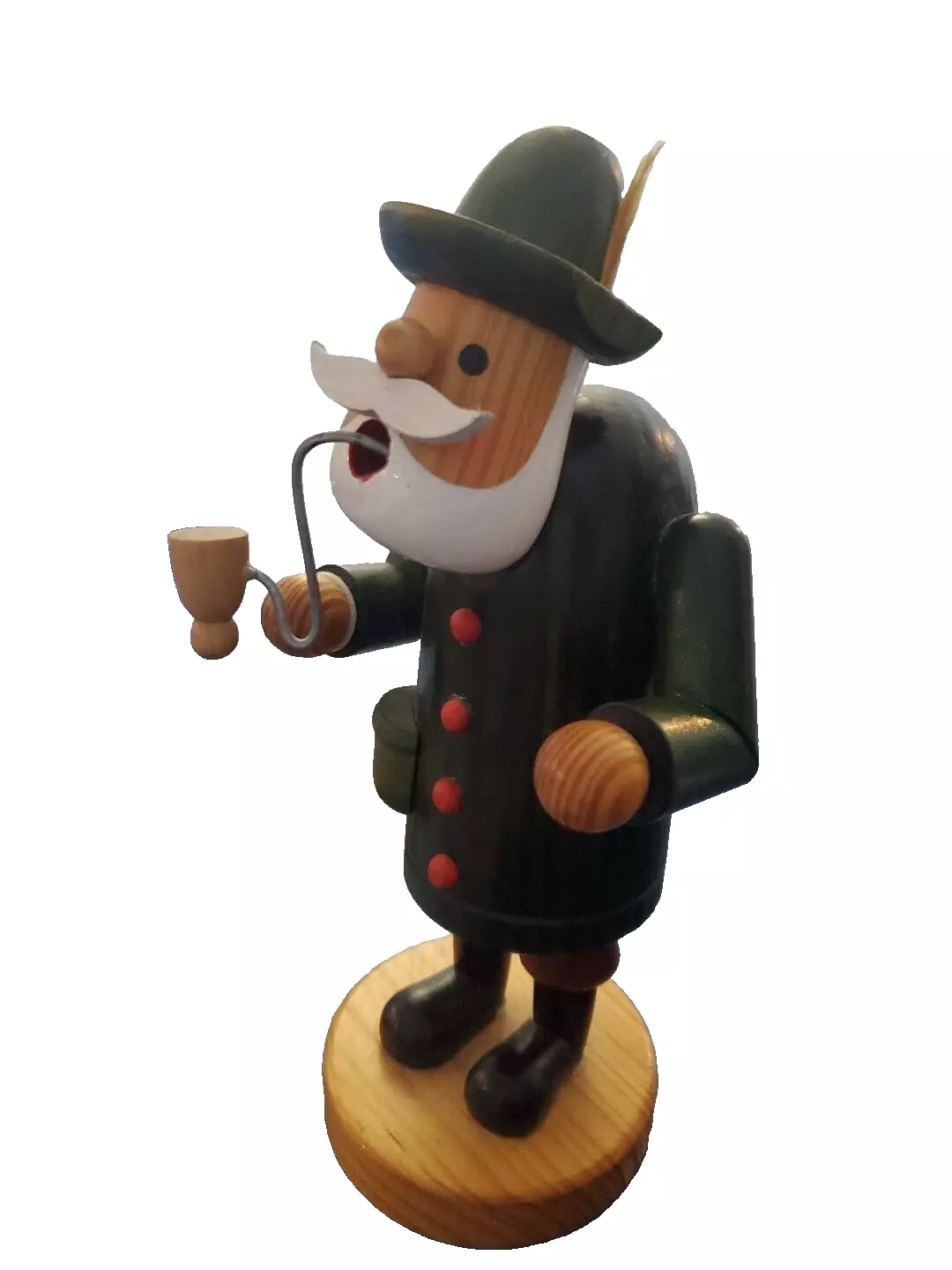
Clock-Men resemble the wooden figures on a cuckoo-clock, or other wooden figures such as nutcrackers. They have bodies carved of wood, with inner workings composed of metal and gears. They generally stand around four feet tall, and have exaggerated, toy-like proportions and round bodies and heads. Their heads have painted-on eyes, rosy cheeks and nutcracker-like mouths that open and close as they talk. Most of them dress in dapper clothing and have wooden mustaches. 


Due to their internal clocks, Clock-Men constantly emit a ticking sound. This is considered highly annoying by most people, and makes stealth difficult. 


They are capable of showing very rudimentary expressions on their faces. This is done solely for the benefit of other races- they do not actually feel emotions. Their voices sound tinny and metallic.


Maintenance 

A digression on Magic- as all know, energy must come from somewhere, and the effects magic has on the world must be powered by something. The current leading scholars theorize that magic is powered by the caster's soul, which each spell cast draining a small section of it. This also explains why wizards tend to live so long- just like magnets can pull metal toward them, so too does the underworld pull souls toward it, with the effects of this drag causing the body linked with the soul to slowly fall apart. Beings with smaller souls experience less pull and thus age slower. 

Clock-Men do not need to eat or drink, being entirely powered by magic. They do however, require vast amounts of magical energy to be exerted to power them. Clock-Men have created a level 1 spell called The Working. Every casting of it recharges the vast amounts of magical energy required to power the city of Clock-Men. Clocktower's Reach contains an underclass of servants whose sole job is to cast the spell repeatedly. Compared to the hard-labor that peasants of most other settlements have to perform, this is a relatively cushy position.  


Clock-Man Wood-carver, showing off toys


Psychology

Clock-Men ultimately only care about one thing, which is building the tower. Anything that would make the tower bigger is morally good to them, and anything that would slow its growth or result in its destruction is bad. They may appear to be engaged in other activities but make no mistake- everything they do ultimately serves their sole purpose.


The Clock-Men have surprisingly good interactions with other civilizations. They believe in diplomacy and fair trade- they've done the calculation, and provoking war is likely to lead to damage to the precious clocktower. They don't truly have any customs or traditions of their own, but will adopt customs and traditions of other folk to fit in. 


The Clock-Man City

The Clock-Man "city," commonly called Clocktower's Reach, is a dense wooden maze that has sprung up around the tower, optimized for the distribution of resources rather than for aesthetics or ease of use. Streets split up and join in random patterns, webs of random walkways connect buildings. The city is a cacophony of noise- everything emits constant ticking sounds, and every hour all the clocks on the tower erupt with loud chiming sounds. 


A decent number of non Clock-Men live in the city. There are barracks containing peasants trained to cast the spells to power and incarnate clock-men, who are kept well-fed and safe. Clock-Men also engage in fosterage- the system where noble children are sent to be raised by other nobles to cement alliances and bonds. The children raised by Clock-Men are typically healthy, but often have trouble fitting in when they return to their hometowns. 


I just really like cuckoo clocks


The Infinite Clocktower

A giant wooden structure that juts out in every direction, with thousands of clocks adorning random surfaces. Makes absolutely no sense internally or externally. Windows are built at odd angles where nobody can see in or out. Staircases are built on the outside, leading to nowhere. Inside are random bits of cloth and wood that roughly approximate furniture, but shaped improperly to have any actual function. 


Every hour on the hour a thousand cuckoo clocks go off at once. Birds pop out of the walls, statues come out to do dances, little men saw wood, etc. It's probably full of cool treasure and other crazy stuff. 


Encounters with Clock-Men

1. A defective Clock-Man on the run. Wants to see the world and be free. If the number appearing roll was higher than 1, the rest are nearby hunting this one down, and will reward its capture handsomely. 


2. Clock-Men on a mission of trade. Attempting to hire themselves out as henchpeople in exchange for casting spells on them. 


3. Clock-Man missionaries (see holy experimentation in Clock-Man characters below) attempting to convert people to their religion by putting on a play. Peasants are watching, vaguely curious but not particularly convinced. 


4. Building an adorable wooden tower to serve as an outpost in this area. 


Clock-Man Loot

When encountered in their lair, clock-men have: 

1. 60% chance to have 1d6 x 1000 gp.


2. 60% chance to have an Fancy cuckoo clock, which are worth a lot of money. Roll 1d4:

  1. Depicts a mausoleum in a cemetery, with a raven as the bird. Every hour a group of pallbearers emerges carries a coffin labelled with the name of one of someone in the world who has died in the past hour across the front of the clock. Worth 1300 gp.
  2. Depicts a history of the clock-men in miniature over 12 hours, with a short scene playing every hour. Worth 1400 gp. 
  3. Fancily carved to look like a coat-of-arms depicting a dragon and a unicorn holding the clock. 500 gp. 
  4. Exquisitely detailed woodland cottage. Every hour figurines come out of the cottage and dance as a strangely melancholy tune plays. 1000 gp.

3. 30% chance to have a random magic potion plus one of the following:

  1. Obedient Cuckoo Clock: A cuckoo clock, but inside are 12 tiny birds, each in a different color. Each one can be given a single command once ever which it will carry out loyally, after which it will fly away. 
  2. Clock-Man Sword: A +1 2-handed sword with a ticking clock embedded in the handle. Targets struck by the sword age 1d6 years. 
  3. Clock-Man Soldier Coat: Stats as plate mail +2 but carved out of wood. Large wooden clock on the back, constant ticking makes stealth near impossible.
  4. Clock-Man Smoking Pipe: A pipe carved out of wood. If smoked creates a giant cloud of colorful smoke, covering a sphere 10' in diameter. Blocks all vision aside from the smoker and that of Clock-Man. 


This could be you!

Clock-Man Characters

You can play as a Clock-Man if you want (we all know you're not going to play as a Clock-Man, but I wanted to write this part).


It may seem strange for a Clock-Man to want to become an adventurers. But while uncommon it is not completely unknown. Some possible reasons may be:


1. Defective: The character was constructed wrong and has wandered out of the city due to a programming error. Other clock-men see them as something akin to a cancerous growth, if they catch them they will haul them back to the city and disassemble them for parts. 


2. Information Gathering: The character has been sent to observe the wider world and report back what they find out. The character must periodically pull out their less important memories and mail them back via adorable wooden messenger pigeons. 


3. Sleeper AgentThe clock-oracles have predicted an event that will occur in the future which the character will be present at and influence in some way. The character is not aware of what their actual mission is. 


4. Peace CorpsFor diplomatic reasons it's beneficial for other kindreds to see clock-men positively. The character has been sent to live amongst others to build goodwill toward clock-men in general. They will be expected to be polite to everyone and help others with their stupid problems. 


5. Holy ExperimentationClock-Men's brains are not built to have faith in things, but they are capable of experimentation and understanding. The character has been tasked to become a priest of a specific religion, carry out their will, and pray to them. Their efficacy will be compared with that of other clock-man priests to determine the most effective god, at which point the clock-men will convert to their religion and start building temples to them. 


6. Learn MagicAlthough Clock-Men are physically powered by magic, over time the amount of magic required to keep the original spell going has become weaker and weaker, and in several centuries the clock-men will cease to function. The character has been sent to learn magical secrets in the hopes of discovering a way to prevent the Clock-Man apocalypse from occurring. 


Race-as-Class:

If you're playing 5e just use the Warforged class. 


For B/X use the Dwarf class then chop out all the abilities and replace them with the following: 


Navigation: Due to their photographic memory, a party containing a Clock-Man reduces the chance of losing direction when travelling by 1-in-6.


Mechanical Body: Clock-Men don't need to eat, drink, or breathe. PC Clock-Men are affected by poison and disease, sorry man. 


Mechanical Mind: Clock-Men are immune to mind-affecting spells such as charm, hold, and sleep spells.


Tough Body: Clock-Men have a base armor class of 13 when unarmored. If wearing armor they gain a +1 bonus to their armor class. 


Flammable: Due to the wood used in their construction Clock-Men are extremely flammable. Against fire attacks they get -2 to saving throws and +1 damage per die rolled. 


InitiativeClock-men get a -1 penalty to initiative due to stiff movement if using individual initiative. 


Separate Race and Class

If using separate race and class they get everything above plus:


Resilience: Clock-Men are durably made, and get a +4 bonus to all saving throws versus Death/Poison.


Weapon RestrictionClock-Men may use any type of weapon of normal or small size but may not use long bows nor two-handed swords.